
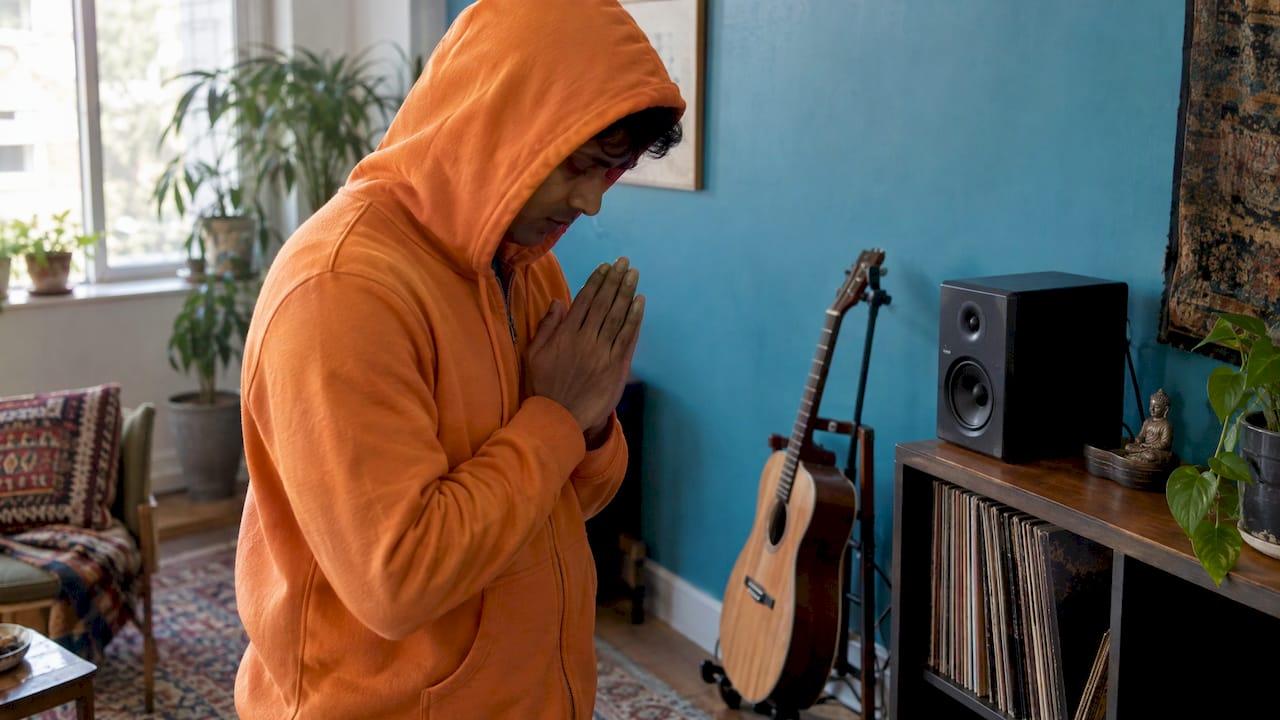
Energy healing music is sound made to help you settle, feel and reset. It draws on chant, drones, drums, repetition and devotional song. The research is clearest on one point: music you choose and connect with can lower stress and lift mood. The tradition is clearest on another: chant and mantra have been used for healing for thousands of years. If you want that tradition in a form that moves, Tantric Guru fuses Vedic Hindu aartis and mantras with electronic dance music. You can feel the rhythm even if you don't know the words.
TL;DR
- Energy healing music covers many traditions: mantra, chant, gongs, drums, binaural beats and devotional song. What they share is repetition, simplicity and a calming intent.
- A meta-analysis of 104 randomized trials found music reduces stress, in both body measures and self-reported feelings.
- Small studies of Vedic chanting and OM chanting report lower anxiety, blood pressure and heart rate after short listening sessions.
- A routine works better than a playlist: pick a time, a length, a track you like and a way to close the session.
- Tantric Guru's aarti and EDM tracks are on Spotify, Apple Music, YouTube Music, Amazon Music, Tidal and iHeartRadio.
Table of Contents
- What energy healing music actually is
- Where Vedic chant and aarti fit
- What research says about stress, mood and loneliness
- About Hz claims: 432, 528 and the rest
- How to build a listening practice
- Music for emotional balance, grief and loneliness
- Where Tantric Guru fits
- FAQ
- Sources
What energy healing music actually is
The phrase has no single definition. A 2026 paper on sound healing as music medicine describes it as a broad term that takes in sound baths, binaural beats, mantras, tuning forks, gong baths, shamanic drumming and sound massage. A typical session of sound immersion runs from 15 minutes to an hour. The same paper traces healing sound back to ancient Egyptian chanting, Greek instruments and the Australian yidaki, a wind instrument whose use is said to go back 5,000 years.
So "energy healing" is better read as a purpose than a genre. You listen to feel calmer, lighter or more present, and the music is built to help.
Researchers have also looked at what such music sounds like. A 2023 study in PMC built a dataset of 165 healing-music pieces and found that most of the 370 acoustic features it measured, 74.59%, were shared across genres. Healing music is not one sound. It has distinctive markers, including particular roughness and timbre features, but it comes in many styles.
Three traits show up again and again:
- Repetition. A phrase or rhythm returns until the mind stops tracking it.
- Simplicity. Few notes, few ideas, plenty of space.
- Intent. The listener sits down to feel something shift, not just to have background noise.
Silvia Nakkach of the California Institute of Integral Studies calls these "medicine melodies": simple, repetitive tonal patterns found in every tradition, from lullabies and Gregorian chant to Indian kirtans, mantras and ragas, Tibetan ritual prayers, Sufi zhikrs and Buddhist sutras. She describes them as built with minimalism and repetition to carry emotion, memory and spiritual transmission.
Where Vedic chant and aarti fit
If you came here through Hindu devotional music, you are already inside this tradition. An aarti is a devotional song sung while offering light to a deity. A mantra is a sacred syllable or phrase repeated for focus. A dhun is a repeated devotional melody. Bhajans and chants from the Ramayana, the Bhagavad Gita and songs to Krishna all work on the same principle: a simple line, returned to again and again.
A 2021 review of music and healing rituals notes that traditions around the world use repetitive group chanting as a spiritual practice believed to support healing and deep meditative states. It lists Native American song, Indigenous Australian chanting, Buddhist sutra recitation and Hindu mantra chanting among them. People in very different cultures arrived at the same tool.
There is a second point that matters for newcomers. You don't need to understand Sanskrit or Hindi to be moved by an aarti. The sound carries the effect before the meaning does. Many listeners start with the rhythm and the voice, and learn the words and stories later.
That is the idea behind Tantric Guru. Our tracks put ancient aartis and mantras over modern electronic rhythms, so the chant becomes something you can dance to, work out to or sit still with. It is designed to let you reach a meditative, joyful state whether or not you know the lyrics.
What research says about stress, mood and loneliness
Healing language is one thing. Measured effects are another. Here is what the evidence says, kept to what a listener can use.
Music and stress
A meta-analysis of 104 randomized controlled trials, with 9,617 participants, found that music interventions reduced stress in both physiological outcomes (an effect size of 0.380) and psychological outcomes (0.545). The effect was larger for heart rate (0.456) than for blood pressure (0.343) or hormone levels (0.349). In plain terms, music helps the body slow down and also helps people feel less stressed.

A 2021 literature review explains the likely route. Listening to music acts on the hypothalamic-pituitary-adrenal axis, the body's stress-response system, and on the autonomic nervous system. Together these can lower cortisol, the stress hormone, and reduce sympathetic activity, the "fight or flight" side of the nervous system. The review also notes that effects were seen across genres.
Vedic chant and OM
Two studies are closer to this tradition. In a 2017 randomized trial in the Indian Journal of Psychiatry, 199 patients about to have an upper GI endoscopy listened for 10 minutes to recorded Vedic chants (the Purusha Suktam). Their anxiety scores fell significantly, from 40.4 to 38.5. Indian classical instrumental music also cut anxiety scores, from 41.8 to 38.0, and lowered systolic blood pressure from 131.8 to 126.1 mmHg.
A February 2023 Cureus study of 50 medical students tested 20 minutes of OM chanting. Systolic pressure dropped from 112.76 to 107.68 mmHg, diastolic from 70.56 to 65.04 mmHg and heart rate from 70.66 to 68.26 beats per minute. Heart-rate variability, a marker of how flexibly the nervous system responds, rose from 64.35 to 73.54 milliseconds.
These are short sessions and modest samples, so treat them as encouraging signs and not as medical treatment. They do show that a few minutes of chant can register in the body.
Loneliness and mood
A 2020 study of 90 participants found that listening to self-selected music reduced loneliness and raised empathy and mood. The authors describe music as a kind of social surrogate, a stand-in for a friend. The detail that matters is self-selected. The music worked because the listener chose it.
About Hz claims: 432, 528 and the rest
Search results for this topic are full of tracks labeled 432 Hz, 528 Hz, 417 Hz or 963 Hz, each said to do something specific. You will see them, so here is a practical way to handle them.
The studies above did not rest on a magic number. The stress meta-analysis covered music of every kind, and the 2021 review found effects across genres. The Cureus study did use OM chanting at 528 Hz, and the results were good, but chanting, a quiet setting and 20 minutes of attention were all part of that session.
The lesson is to choose what draws you in. If a tuning sounds warm to you, enjoy it. If a track with a driving beat and a chanted aarti lifts you, that counts too. The loneliness study points the same way: the listener's own choice matters more than a label on the video.
How to build a listening practice
A playlist on in the background is pleasant. A practice is what lets the music do its work. Here is a routine you can run in 15 to 20 minutes, in line with the session lengths in the research above.
- Choose one purpose. Settle, energize, release or reflect. Different tracks suit each. A slow chant suits settling. A track with a beat suits a workout or a morning reset.
- Pick the track before you sit down. Scrolling mid-session breaks the effect. Choose something you already like, since self-selected music is what the loneliness research tested.
- Set the length. Ten minutes matched the Vedic chant trial, and 20 minutes matched the OM study. Start with 10.
- Use headphones or a good speaker, at a comfortable volume. The OM study ran at 60 to 70 dB, about the level of ordinary conversation. Loud is not better.
- Anchor your attention. Follow the repeated phrase, the beat or your breath. When your mind wanders, return to the sound. That return is the practice.
- Close the session on purpose. Sit for a minute after the music ends. Notice your breathing and your shoulders before you reach for your phone.
Some people add a sensory cue to make the ritual stick. A few slow breaths with pure essential oil inhalers before you press play can mark the start of the session. Others light a candle or a lamp, which echoes the light offered in an aarti.
For movement, the same logic applies. Bhajan clubbing and spiritual workout music turn the chant into rhythm. Pick a track, commit to its full length and let the repeated mantra set your pace.
Music for emotional balance, grief and loneliness
Many readers come to this topic at a hard moment. Music can keep you company at those times, and a few habits help it do that.
Match the mood first, then shift it. If you are sad, start with something slow and warm that fits how you feel. After a few minutes, move to something steadier. Starting with forced cheer can feel false.
Pick familiar over new when you are raw. Familiar sounds ask nothing of you. A chant you know, even by sound alone, can feel like a hand on your shoulder.
Use repetition as a container. Grief and loneliness often bring looping thoughts. A repeated mantra gives the mind one loop that is gentle. This echoes Nakkach's point that simple, repeated tonal patterns are used across traditions to carry emotion.
Pair listening with a small action. Journal a few lines, take a short walk, or message a friend afterward. The loneliness study found music worked as a stand-in for a friend, but it is meant to lead you back toward people, not replace them.
Know when to reach for more. If sadness or isolation lasts for weeks, gets in the way of sleep, work or eating, or you have thoughts of harming yourself, talk to a doctor or a licensed mental health professional. In the US, you can call or text 988 to reach the Suicide & Crisis Lifeline at any hour. Music is a support for your days, and it sits beside care for a hard stretch.

Where Tantric Guru fits
If you want a different sound than the usual whale songs and ambient pads, Tantric Guru is built for you. We blend ancient Vedic Hindu aartis and mantras with modern EDM, so the sacred text rides on electronic rhythms. It suits spiritual seekers, EDM fans curious about cultural fusion, anyone exploring meditation through music, and listeners who want something uplifting and positive.

Our original tracks are available to stream or download on Spotify, Apple Music, YouTube Music, Amazon Music, Tidal and iHeartRadio. Start with one track, run the 10-minute routine above, and see how it feels. You can find the music at tantricguru.com.
FAQ
Does energy healing music really work?
The best evidence is for stress and mood. A meta-analysis of 104 randomized trials found music reduces stress in body measures and self-reported feelings, and smaller studies of Vedic and OM chanting report lower anxiety and blood pressure. Results are strongest when you choose music you like and listen with attention.
Do I need to understand the lyrics of an aarti or mantra?
No. The sound, rhythm and repetition carry much of the effect, and many people learn the meaning later. Tantric Guru's tracks are designed so you can reach a meditative, joyful state whether or not you know the words.
How long should I listen?
Start with 10 minutes, the length used in the Vedic chant trial, and extend to 20 once it feels natural. Sound immersion sessions in the wider literature run from 15 minutes to an hour. Consistency counts for more than length.
What music helps with loneliness or grief?
Choose something familiar that fits your mood, then move gradually toward something steadier. Studies suggest self-selected music can ease loneliness and lift mood. If the heaviness lasts for weeks or affects your daily life, talk to a doctor or a licensed mental health professional.
Sources
- Sound Healing as Music Medicine (2026)
- Uncovering potential distinctive acoustic features of healing music (PMC, 2023)
- Cosmic Music: The Emotional Magic of Medicine Melodies (CIIS)
- Music and Healing Rituals (Perry and Polito, 2021)
- Effects of music interventions on stress-related outcomes: two meta-analyses (UvA-DARE, 2020)
- Listening to music as a stress management tool (PMC, 2021)
- Effect of listening to Vedic chants and Indian classical music (Indian Journal of Psychiatry, 2017)
- Short-Term Effect of Spiritual Music on Heart Rate Variability in Medical Students (Cureus, 2023)
- Music May Reduce Loneliness and Act as Social Surrogate for a Friend (2020)