
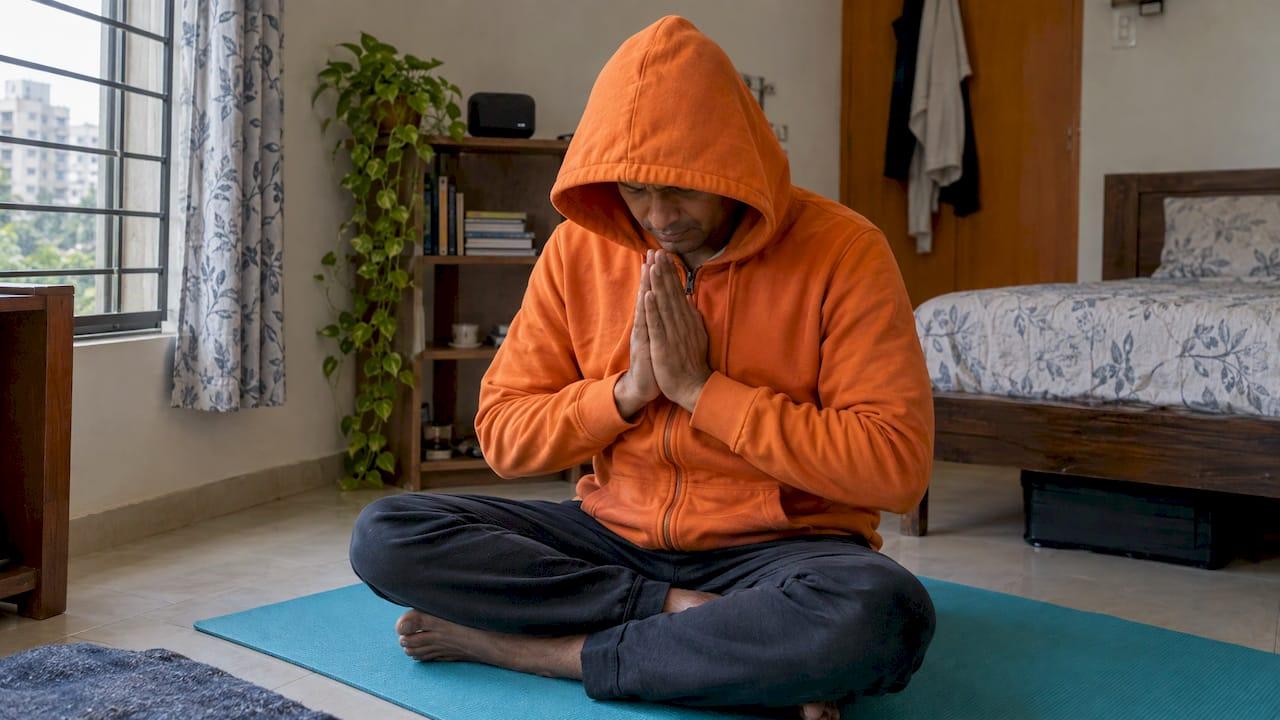
The best morning meditation music is the kind that helps you settle quickly, holds a steady volume and pace, and ends when your session does. For most people that means slow, mostly instrumental sound for a calm start, or a rhythmic, mantra-led track if you want to wake up with energy. If you like the second route, our own work sits there: original tracks that blend Vedic Hindu aartis and mantras with electronic dance music, made so you can feel the meditative mood without needing to understand the lyrics.
This guide shows how to choose by mood, tempo and time available, how to structure a 10-minute session, when a long track makes sense, and how bedtime music differs.
TL;DR
- Meditation music is defined by what it does, not its genre: any sound that helps you settle and focus. Ambient, nature sounds, chant, bowls and instrumentals all qualify.
- Match the track to your time: about 10 to 15 minutes for a calm-down, 15 to 30 for getting ready, and longer only when you have the time to stay with it.
- For a calm, intention-setting start, pick slow music with a steady drone underneath. For an energetic start, pick rhythmic, repetitive music that builds.
- Try one type of audio for several mornings before judging it, and keep the volume consistent.
- Bedtime music is slower, shorter on surprises and paired with a timer. Morning music can carry more rhythm and lift.
Table of Contents
- What morning meditation music actually is
- Choosing by mood: calm start or energized start
- Four dials: tempo, lyrics, familiarity, memories
- A quick checklist before you commit to a track
- A 10-minute morning session with music
- Short, quick and 10-minute tracks: how they differ
- When long meditation music makes sense
- Where devotional and electronic fusion fits
- Listen to Tantric Guru in the morning
- Bedtime meditation music versus morning music
- Building a morning routine around the music
- FAQ
- Sources
What morning meditation music actually is
Meditation music is less a genre than a function: any sound used on purpose to quiet the nervous system and make it easier to enter a focused or restful state. That is why the label covers such different things. Common types include ambient and drone, nature soundscapes, singing bowls and gongs, chant and mantra, and instrumental or classical pieces.
A mantra is a short sacred phrase repeated for focus. An aarti is a Hindu devotional song of praise, traditionally sung with a lamp offering. Both rely on repetition, which is the same property that makes ambient music useful for meditation: the sound is predictable enough that you stop analyzing it.
For mornings, Emotiv's overview of meditation music lists the core ingredients as nature sounds such as rain, water and birdsong, slow ambient tones with no strong melody, slow instrumental pieces with piano, flute or bells, and chanting such as a repeated "Om". Morning tracks add one more option: a quiet beat. A gentle rhythm can help you move from sleep into the day without the drop in energy that very sparse ambient sound can bring.
Choosing by mood: calm start or energized start
Before you press play, decide what you want the next ten minutes to do. Two different morning goals call for two different kinds of music.
For a calm, intention-setting start
Wanderlust's piece on two meditative states that work best with music quotes Charlie Knoles recommending slow, calming instrumental music with an underlying drone, such as an organ, synth or harmonium, with a melody on top. He says you can find it in traditional Indian kirtan, mellow downtempo electronic music or church music. The drone grounds you first, and then you introduce your intention for the day.
Kirtan is call-and-response devotional singing, and a harmonium is the small hand-pumped reed organ often heard in Indian devotional music. If you already enjoy bhajans or aartis, this is a natural fit: the drone and the repeated phrases do the settling for you.
For a flow-state, high-energy start
For the second state, the same article recommends repetitive, rhythm-based music that starts slow and builds, as in chant and trance traditions including EDM. This is the morning you want if sitting still feels impossible, if you plan to stretch, walk or do a workout after, or if you simply want to wake up. A track with a steady four-on-the-floor pulse and a repeated mantra can hold your attention without demanding thought.
This is the space Tantric Guru is built for. Our tracks pair electronic rhythms with sacred mantras and aartis, so the beat carries momentum while the Sanskrit phrases stay the emotional center. You can enjoy it as a meditative state whether or not you know what the words mean.
Four dials: tempo, lyrics, familiarity, memories
A useful way to compare tracks comes from Mentally United's playlist guide, which suggests four dials: tempo in beats per minute (BPM), lyrics, familiarity and memories.
- Tempo. Slower tracks tend to settle you; faster ones lift you. The same guide notes that sleep-music studies most often use about 60 to 80 BPM. For a morning wake-up, you can go faster than that.
- Lyrics. Verywell Mind's Elizabeth Scott, PhD advises preferring music without lyrics, because words engage the conscious mind. Mantra is the useful exception: a phrase repeated many times stops carrying meaning to analyze and becomes texture. If lyrics in a language you understand pull you into thinking, a Sanskrit mantra is a way to keep the voice without the storyline.
- Familiarity. A familiar track needs less attention. A brand new one can be exciting but may pull you out of focus. Many people keep one or two go-to tracks for weekdays and save new music for weekends.
- Memories. A song tied to a stressful commute or a past relationship will bring that along. Pick music with neutral or positive associations.
Verywell Mind also suggests choosing music you actually enjoy, since a track you dislike works against you however calm it is supposed to be.
A quick checklist before you commit to a track
Kin Fix Health's guide to choosing meditation music for different times of day offers questions that translate well into a morning check. After a session, ask yourself:
- Did the sound help me settle?
- Was the volume consistent, with no sudden jumps?
- Were there abrupt changes that pulled me out?
- Could I focus without following the melody?
- Did it suit what I wanted from the session?
The same guide suggests sticking with one type of audio for several sessions before deciding. The first morning is often distorted by novelty or by an unusual mood, so a few days of the same track give a fairer picture.
A 10-minute morning session with music
Ten minutes is a common daily length. A short session needs a simple shape because there is no time to wander. Here is a structure that works with almost any track of that length.
| Minutes | What you do | What the music should do |
|---|---|---|
| 0 to 1 | Sit, close your eyes, take three slow breaths | Fade in softly, no sudden start |
| 1 to 4 | Follow your breath, let thoughts pass | Hold a steady drone or repeated phrase |
| 4 to 8 | Stay with the sound, or silently repeat a mantra | Stay steady; a repeating mantra works well here |
| 8 to 10 | Set one intention for the day, then open your eyes slowly | Build gently or fade out without a hard stop |
Two things commonly go wrong. The first is fiddling: skipping tracks, adjusting volume and checking the clock all break the session. Queue the track before you sit and use a track that ends at about ten minutes, so no timer is needed. The second is choosing music that peaks too early. A track that hits its loudest section at minute three leaves you flat for the rest.
If you want a rhythmic version, choose a track that starts sparse and builds. That mirrors a pattern that Bright Star Events described in a spiritual-electronic mix: opening ambient textures, a devotional-vocal middle with Sanskrit mantras over deep house, then a rhythm-focused finish. The arc is to establish calm, deepen into the theme, then return to beat and momentum, which is also a good model for a morning that ends with you moving.
Short, quick and 10-minute tracks: how they differ
A 10-minute track is a full session. A "short" or "quick" track, say two to five minutes, is better thought of as a reset. Tunee AI's meditation-music guide suggests matching length to practice: 5 minutes for beginners, 10 to 20 minutes for daily practice, and 30 to 60 minutes for deep sessions.

For a short track, skip the structure above. Take a few breaths, listen for the first sustained note or phrase, and spend the rest of the time on one thing: breath, a mantra, or the sound itself. Short tracks suit days when you are rushed, and a five-minute habit you keep beats a thirty-minute one you skip.
Mentally United gives a similar rule of thumb for playlists: about 10 to 15 minutes for a calm-down and 15 to 30 minutes for getting ready. Treat those as ranges to try rather than fixed targets.
When long meditation music makes sense
Long or extended tracks, from 30 minutes up to an hour or more, are for sessions where you have the time and want to go deeper: a weekend sit, a yoga flow, journaling, or a slow start to a day off. Tunee puts deep sessions at 30 to 60 minutes.
When choosing something long, look for:
- A stable middle. Over a long stretch, a track with constant surprises becomes tiring. You want slow change, with elements added or removed gradually.
- A gentle ending. A hard stop after 45 minutes is jarring. Look for a fade or a soft return to rhythm.
- A shape you can trust. Long mixes that follow an arc from calm to theme to momentum let you relax into the structure instead of wondering what comes next.
Mantra-based electronic music suits long sessions because of repetition. Bright Star Events' feature on a Deva Premal and Miten remix describes cyclical mantra repetition set against an unchanging, spacious electronic landscape, with more than seven minutes of production giving room for the listener's inner response. That principle, that the power of sacred sound lies in repetition, is why a few long mantra tracks can carry a full session.
If you do not have an hour, a playlist of three or four tracks of similar mood is an easy way to reach 20 to 30 minutes without choosing a single long file.
Where devotional and electronic fusion fits
Not everyone wants harp and rainfall at 6:30 a.m. Fusion of devotional music and electronic rhythm has a long track record in wellness spaces. In its feature on a Sri Kala remix, Bright Star Events explains that kirtan has moved into global wellness settings over the past two decades, mostly acoustically, and that EDM can add propulsive, community-oriented power. In the best examples, the devotional elements are the emotional center of the track and not decorative samples.
That is also how we approach it at Tantric Guru. Our tracks blend ancient Vedic Hindu aartis and mantras with modern EDM, so the electronic pulse supports the meditative state instead of replacing it. Here is how listeners typically use that kind of music in a morning:
- Wake-up listening. Play a rhythmic mantra track while you make tea or stretch, then sit quietly for the last few minutes.
- Spiritual workout. Use a driving aarti track as a warm-up or for a walk, run or yoga flow.
- Bhajan clubbing at home. Treat a longer set as a small private session, dancing or swaying for the first half and settling into stillness for the second.
Meditation Review's guide to energizing morning music lists chanting and mantras and drumming or percussion among the popular options for a higher-energy start, alongside nature sounds with soft beats and uplifting instrumentals.
Listen to Tantric Guru in the morning
If you want a morning soundtrack where Krishna aartis, Vedic mantras and Hindu prayers meet electronic dance rhythm, our original tracks are available for streaming and download on major platforms including Spotify, Apple Music, YouTube Music, Amazon Music, Tidal and iHeartRadio. They are made for spiritual seekers, EDM fans and anyone exploring meditation through music, and you do not need to understand the lyrics to feel the mood.

Start with one track on your usual platform, use it for a few mornings in a row, and see how it settles you. You can find everything at Tantric Guru.
Bedtime meditation music versus morning music
The same tools work in the evening, but the goals reverse. In the morning you want to arrive and gain energy. At night you want to let go.
| Morning | Bedtime | |
|---|---|---|
| Goal | Calm focus or gentle energy | Winding down toward sleep |
| Tempo | Slow to moderate, can build | Slow, steady; sleep studies often use about 60 to 80 BPM |
| Sound | Drone, mantra, light rhythm, uplifting tones | Soft pads, low drones, very little change |
| Length | 10 to 30 minutes | About 30 to 45 minutes with a sleep timer |
| Ending | Fade or gentle build | Fade to silence |
The 60 to 80 BPM figure and the 30 to 45 minute wind-down with a sleep timer both come from Mentally United's playlist guide. For bedtime, avoid tracks that build, since a rising beat is exactly what you do not want at 10 p.m. A quiet, drone-based mantra is fine, but keep the volume low and consistent. If sleep problems persist for weeks, talk to your doctor instead of relying on music alone.
Building a morning routine around the music
Music works best as a cue. Pair the same track with the same spot and time and your mind starts to associate them. A simple routine:
- Put your phone on do-not-disturb and queue the track the night before.
- Drink water, then sit for your session.
- Finish with one intention, spoken or written.
- If you want energy, follow with movement and a rhythmic track.
Change one variable at a time. If you switch the track, the length and the time of day all at once, you will not know what helped.
FAQ
What is the best length for morning meditation music?
Ten minutes is a good starting point for a daily practice, with 5 minutes as an easy entry and 15 to 30 minutes when you have more time. Match the track to the session you plan to do, so you are not watching the clock.
Can I use music with lyrics for morning meditation?
Yes, if the words do not pull you into thinking. Lyrics in a language you understand can engage the conscious mind, which is why many people prefer instrumentals. Repeated Sanskrit mantras work differently, since the repetition turns the words into texture.
Is EDM suitable for morning meditation?
It can be, especially for a flow-state or high-energy start. Choose a track that begins slowly and builds, with repetitive rhythm and a steady volume. Our tracks combine EDM pulse with Vedic aartis and mantras for exactly that kind of morning.
How is bedtime meditation music different from morning music?
Bedtime music is slower, changes less, and is usually played for about 30 to 45 minutes with a timer. Morning music can carry more rhythm and lift, since the aim is to start the day, not to fall asleep.
How long should I try a track before deciding if it works?
Give one type of audio several sessions. Judge it by whether you settled, whether the volume stayed even, and whether you could focus without following the melody.
Sources
- Meditation Music: The Complete Guide
- Emotiv: Meditation Music
- Wanderlust: Two Meditative States that are Best with Music
- Mentally United: Playlists for every mood and mode
- Verywell Mind: How to Practice Music Meditation
- Kin Fix Health: How to Choose Meditation Music for Different Times of the Day
- Bright Star Events: Spiritual Electronic Music Mix
- Bright Star Events: Lean On Krishna
- Bright Star Events: Gaia Ma Liquid Bloom
- Meditation Review: Energizing Meditation Music
- Tunee AI: Meditation music