
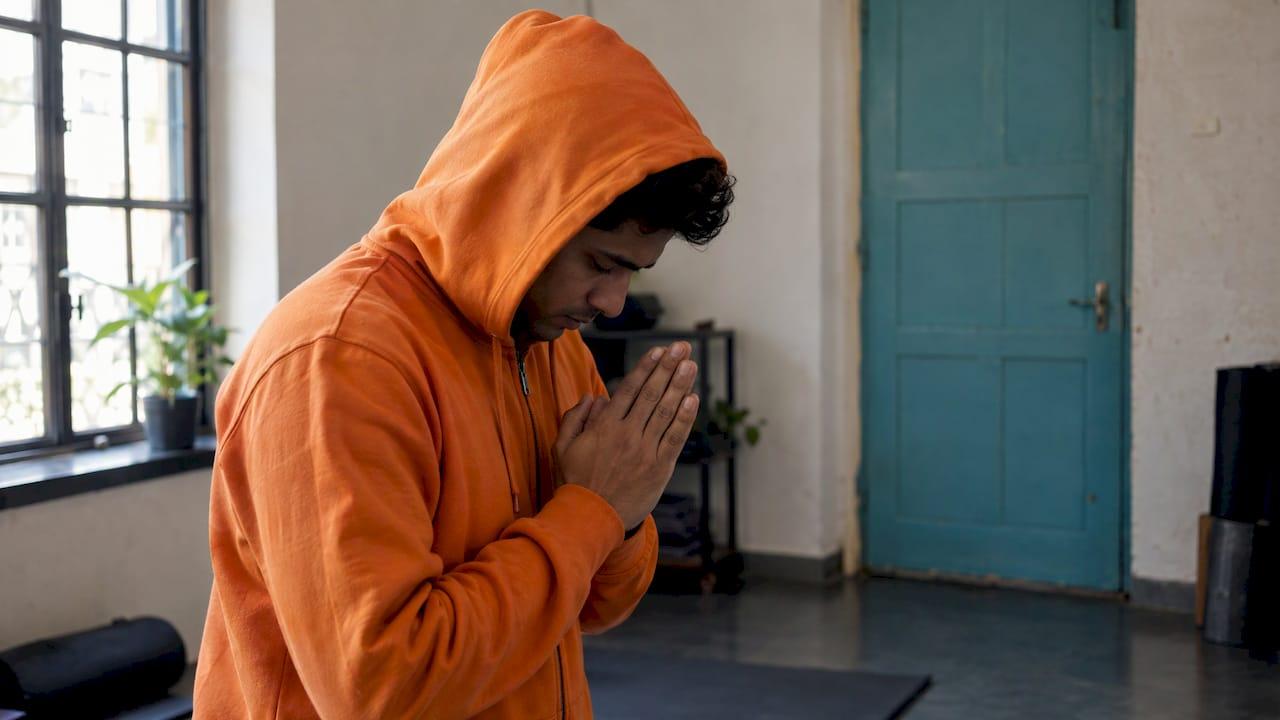
“Buddham saranam gacchami” means “I take refuge in the Buddha.” It is a line in Pali, the old language of the Theravada Buddhist scriptures. Buddhists have recited it for centuries as the first of three refuge statements, and it is often the first thing a person chants when they begin formal practice. You can chant it, listen to it, or simply want to know what the phrase says before you press play. This guide gives you the word-by-word meaning, the other two lines, how to pronounce it, when it is used and why a slow chant tends to settle the mind.
TL;DR
- Meaning: “I take refuge in the Buddha,” or more literally, “I go to the Buddha for refuge.”
- The full set: it is the first of three lines. The other two take refuge in the Dhamma (the teaching) and the Sangha (the community).
- Use: it opens daily chanting, retreats and ceremonies, and it comes before the five precepts are taken.
- Say it: hold the long vowels, and expect the final “-am” to sound close to “-ang” in many traditions.
- Listening: you do not need to be Buddhist to find a chant calming, and research on chant supports that.
Table of Contents
- What the words mean
- The full Three Refuges
- How to pronounce it
- When the refuge chant is used
- Why a slow chant calms people
- Chant and modern music
- Sacred chant with a beat
- FAQ
- Sources
What the words mean
The phrase has three words. A Pali lesson from National Taiwan University breaks them down like this: buddhaṃ is “the Awakened One,” from the root budh, “to awaken.” Saraṇaṃ is “refuge.” Gacchāmi is “I go.” Both buddhaṃ and saraṇaṃ carry the ending that marks the object of the verb, which is why you see “-am” on both.
| Pali word | Plain meaning | Role in the sentence |
|---|---|---|
| Buddhaṃ | The Awakened One | What you go to |
| Saraṇaṃ | Refuge, shelter | What you seek there |
| Gacchāmi | I go | The action |
Put together, the sentence says: I go to the Awakened One as my refuge. “Buddha” is a title, not a name. It describes someone who has woken up to the way things are, and in the tradition that person is the historical teacher Siddhartha Gautama.
The word “refuge” can mislead English speakers. It does not mean hiding from life. In Buddhist usage it is closer to choosing a reliable guide and a direction. A Theravada teacher, Bhikkhu Bodhi, explains in an essay on going for refuge that the Buddha is the guide who points out the path, the Dhamma is the goal, the path and the instructions, and the Sangha is the community of practitioners who can help others follow it.
The full Three Refuges
The line you searched for is only the first of three. Together they are called the Three Refuges or the Triple Gem. A chanting guide on BuddhaNet gives the full formula:
- Buddhaṃ saraṇaṃ gacchāmi: I go to the Buddha for refuge.
- Dhammaṃ saraṇaṃ gacchāmi: I go to the Dhamma (the teaching) for refuge.
- Saṅghaṃ saraṇaṃ gacchāmi: I go to the Sangha (the community) for refuge.
This answers the other question many people have, which is what “sangham saranam gacchami” means. It is the third line, and it says “I take refuge in the community.” In Theravada texts the Sangha usually means the community of those who have practiced and realized the teaching, as a Thai Vipassana guide describes it. In everyday use many lay Buddhists also hear it as their circle of spiritual friends.
You may also see “dhammam saranam gacchami” spelled with one “m,” “dharmam sharanam gachchhami” in Sanskrit-flavored versions, or “buddham sharanam gachhami” in Hindi and Devanagari renderings. These are one chant in different spellings, not different chants.
Why it is said three times
The three lines are usually repeated in a threefold recitation. The first round is as above. The second round adds dutiyampi, “for the second time,” in front of each line. The third adds tatiyampi, “for the third time.” The same BuddhaNet text lays out this pattern. The repetition marks a firm commitment, not a casual remark, and it gives the voice and breath time to settle into a rhythm.
How to pronounce it
The spellings differ because Pali has no single native alphabet. A guide to Pali pronunciation published by Pariyatti explains that Pali is written in different scripts in different countries, and that the Roman letters with accent marks are a way to represent its sounds. So “Buddham,” “Buddhaṃ” and “Buddhang” are all attempts to write the same sound.
A few rules get you most of the way:
- Long vowels are held. The same Pariyatti guide says ā, ī and ū last about twice as long as short vowels. So gacchāmi has a stretched “aa” in the middle.
- The vowel sounds. BuddhaNet compares the short “a” to the vowel in “what” and the long “â” to the vowel in “father.” It also says to pause briefly on double letters, so “Buddhaṃ” and “gacchāmi” have a small beat before the doubled consonant.
- The final “-am.” In the chanting tradition of the Prairie Sangha, the ending is pronounced roughly “-ang.” That is why you hear “Buddhang saranang gachchhami” in many recordings.
- The “dh” and “bh.” These are a plain “d” or “b” followed by a puff of breath, not the “th” in “the.”
A workable way to say the first line for a beginner is: BUD-dhang SAH-rah-nang gah-CHAA-mee. Go slowly, keep the pitch low and steady, and breathe between lines. Pronunciation is learned by ear, so repeating along with a recording is the natural method.
When the refuge chant is used
According to the Taiwan lesson, the chant is usually recited every morning or as the opening part of a ceremony. It expresses acceptance of the Buddha as teacher, the teaching as guidance and the community as spiritual friends. Other settings include:
- Before the five precepts. A text on the Three Refuges in the Britannica archive says the refuge verses are usually recited before taking the five precepts, the basic ethical training for lay Buddhists.
- At the start of retreats and formal practice. The Prairie Sangha describes it as a Pali devotional practice traditionally performed at the beginning of a retreat or sitting, expressing the intention to take refuge in the Triple Gem.
- Alone, before meditation or sleep. The Thai Vipassana guide notes that people also recite it by themselves at those times.
If you want to build a short morning routine around a chant, our guide to morning meditation music covers how to pick tracks and lengths that fit your time.
Reflection, not just repetition
The Buddhist teacher Ajahn Sumedho, in a teaching reproduced by Buddhism Today, stresses reflection over rote repetition: the words come alive when you ask what “Buddha” and “refuge” mean in your own life. The Thai Vipassana guide frames refuge in a similar way, as a commitment to use the Buddha as teacher, the Dhamma as guide and the Sangha as example and companions, not as handing your responsibility to an outside power.
That gives you a simple practice. Chant the line three times, then sit for a minute and notice what you reach for when things go wrong. The chant is the doorway and the noticing is the work.
Why a slow chant calms people
Many listeners say chanting relaxes them. Recent research gives that feeling some footing. A 2025 study in PNAS examined 242 chants from seven traditions. It found that chants tend to share relatively flat, slowly changing pitch, steady voicing and comfortable, lower pitch ranges. In a playback experiment in the same paper, 61 listeners rated short chant excerpts as more relaxing than excerpts of song or speech.
In practical terms, the features that make “Buddham saranam gacchami” easy to chant are the same ones that make it easy to listen to: few notes, long vowels, an even pace. You do not need to follow the Pali to feel the effect, though knowing the meaning gives the sound a point.
Several things help a listening session work:
- Volume low enough to hum along. Chant is meant to be joined, not just heard.
- A fixed length. Many people pick 3 repetitions for a quick start, or a longer loop for a sit. Decide before you begin so you are not watching the clock.
- One posture. Sitting upright with relaxed shoulders helps the breath carry the long vowels.
For a wider look at sound as a relaxation tool, see our piece on energy healing music.
Chant and modern music
Chant has never been a fixed museum piece. In a 2025 article in Dharma World, the scholar Michaela Mross describes Japanese Buddhist music as including both free-rhythm, melismatic chant, where a syllable stretches across many notes, and syllabic, fixed-rhythm sutra recitation, with instruments marking the stages of a ritual. She also notes that traditional chants continue to be passed down while some younger monastics take part in Buddhist pop, rap and voice-meditation projects.

That is the same impulse behind a lot of today’s sacred sound: keep the words, change the setting. Some listeners prefer a bare voice. Others like a pulse underneath that matches a walk, a run or a long drive.
Sacred chant with a beat
To be clear about what we do: “Buddham saranam gacchami” is a Buddhist Pali chant, and our tracks are not that. Tantric Guru makes original music that fuses ancient Vedic Hindu aartis and mantras with modern electronic dance music. It is designed to give you a meditative, uplifting listen whether or not you understand the lyrics, and the tracks are available for streaming and download on major platforms including Spotify, Apple Music, YouTube Music, Amazon Music, Tidal and iHeartRadio.
If you came to this page because a slow, sacred chant lifts your mood and you wonder what that feeling sounds like with a steady rhythm, start with the Tantric Guru tracks.

If you want to explore sacred words you can chant yourself, 25 mantra examples is a good next read, and our guide to the Nirvana Shatakam gives you the meaning, lyrics and chanting method for another well-loved verse.
FAQ
What does buddham saranam gacchami mean?
It means “I take refuge in the Buddha,” or literally “I go to the Buddha for refuge.” The words are Pali: buddhaṃ is the Awakened One, saraṇaṃ is refuge and gacchāmi is “I go.” It is the first of the Three Refuges.
What is the meaning of sangham saranam gacchami?
It is the third refuge and means “I take refuge in the Sangha,” the community of practitioners. The second line, dhammaṃ saraṇaṃ gacchāmi, takes refuge in the Dhamma, the teaching. Said together, the three lines are the standard refuge formula.
Why is the chant repeated three times?
The formula is recited once, then again with “for the second time” (dutiyampi) and a third time with “for the third time” (tatiyampi). The threefold pattern marks a settled commitment. It also gives you a steady rhythm to chant or listen to.
Do I need to be Buddhist to listen to it or chant it?
No. Anyone can listen, and the slow pitch and long vowels of chant are relaxing for many people. Taking refuge as a formal act is a Buddhist commitment, so if you want to make that commitment, speak with a teacher in a Buddhist community near you.
Sources
- Vandana 2, National Taiwan University Pali lesson
- Pali Chanting in the Theravada Buddhist Tradition, BuddhaNet
- Buddham Saranam Gacchami: the Three Refuges with Meaning, Vipassana Thai
- Going for Refuge and Taking the Precepts, Access to Insight
- Chants, The Prairie Sangha of Urbana-Champaign
- A short introduction and guide to Pāli pronunciation, Pariyatti
- The Three Refuges, Britannica archive
- Buddhism Today, teaching on the Buddha
- Chants across seven traditions share acoustic traits, PNAS 2025
- Dharma World, Autumn 2025