

The best meditation music for focus is slow, soft, steady and something you actually like. It stays in the background, gives your attention a gentle anchor and does not ask you to follow a story. That can be a quiet raga, a mantra over a soft pulse or a slow instrumental piece. What matters is how the sound behaves and how you use it. This guide covers what research says about music and attention, how to choose tempo, volume and style, and how to build a session you can repeat. It also covers concentration and yoga, and the place of devotional and dance-influenced music, which is what we make at Tantric Guru.
TL;DR
- Slow, soft, steady music with few surprises suits focus best. Keep it as the backdrop, not the main show.
- Music you pick yourself and know well tends to help attention more than a stranger's playlist.
- Start with 5 to 10 minutes, use a timer, and bring your attention back to the sound each time your mind wanders.
- Devotional chant and mantra music has a long tradition as a focus tool, and slow electronic rhythm can carry it into a modern practice.
- For yoga, match the music to the phase: more rhythm for flow, slower and softer toward the end.
Table of Contents
- What research says about music and focus
- How to choose tempo, volume and style
- Lyrics, mantras and the language question
- A simple focus session with music
- Meditation music for concentration: work, study and reading
- Music for yoga practice
- Devotional and dance-influenced music as a focus tool
- Music for focus from Tantric Guru
- FAQ
- Sources
What research says about music and focus
Music can help attention, but it does so through specific qualities, not through any one genre.
In a 2025 study of 26 adults, slow-beat music improved attentional orienting. Listeners focused better on relevant targets while ignoring distractors. Their heart rate dropped, and they reported more pleasure and relaxation.
A 2021 study of 108 healthy adults compared jazz, piano and lo-fi focus music with no music. The music groups showed higher heart rate variability, a marker linked to a calmer state. Familiarity went along with faster reaction times while listening.
A 2023 study by Homann, Drody and Smilek found that self-selected background music increased task focus and reduced mind wandering compared with silence in a vigilance task. The effect held whether the task was easy or hard, and attention declined less over time.
Putting these together gives a practical recipe:
- Slow tempo.
- Music you chose.
- Music you know.
- A steady texture that does not jolt you.
The same logic applies whether you are sitting in meditation or working through a to-do list.
Why Indian ragas keep appearing in the evidence
Indian classical music has been studied for its effect on attention. A 2023 meta-analysis of five studies with 71 participants aged 19 to 30 found that listening to rāgas raised alpha EEG activity and attention scores. Alpha activity is the brain rhythm associated with relaxed alertness.
A 2012 cardiovascular review reported that, across styles from raga to techno, raga was the most calming. The same review found that rhythmic phrases about ten seconds long, which match a slow breathing rhythm of roughly six breaths a minute, produced bigger shifts in heart rate and blood pressure.
For a listener drawn to Vedic sound, this is useful. Long phrases, steady pulse and a repeating melodic centre give attention something to rest on.
How to choose tempo, volume and style
You do not need a laboratory. You need three dials and a little honesty about how you respond.
Tempo: slower than your heartbeat, steady throughout
Kimberly Humphrey, a sound healer at Miraval Austin Resort & Spa, explains in The Healthy that fast or loud sounds keep the senses alert to the outside world, the opposite of turning inward. Soft, slow music soothes the body and slows thoughts. For sitting practice, aim for a gentle, even pulse. Avoid sudden drops, big builds and tempo changes that pull you out of the moment.
For concentration work, such as reading or writing, you can go a little brighter, as long as the rhythm stays predictable. A steady beat is easy for the brain to stop noticing, which is exactly what you want.
Volume: low enough that you could hear a knock at the door
The goal is a backdrop. If you catch yourself following every change in the track, turn it down. The nervous system is very sensitive to sound, as Cortland Dahl of Healthy Minds Innovations points out in the same article: the same sound can calm one person and put another on edge. His advice is to find music that is soothing and enjoyable to you and keep it in the background.
Style: familiar texture beats novelty
New music tempts you to analyze it. Familiar music lets attention settle. That is why many people keep one or two tracks for practice and rotate them rarely.
If you are new to this, our guide to meditation music for beginners covers what to play first. If you wonder whether specific tones matter, see our explainer on frequency for meditation.
Lyrics, mantras and the language question
UCLA's Diana Winston recommends very subdued background music without lyrics that is not too evocative, because music is associative and can pull the mind into memories. That is a fair warning about songs that carry personal stories: a pop chorus you know by heart invites a mental sing-along.
Mantras and aartis work differently for many listeners. A Sanskrit or Hindi mantra repeated over a steady rhythm becomes a sound texture, and you do not need to understand the words to feel the effect. That is the idea behind our own approach: you can settle into a meditative state whether or not you know what the lyrics mean. If a track starts triggering a lot of internal commentary, switch to an instrumental version for that session, which is the same advice Verywell Mind gives.
For more on using chants this way, see mantras for relaxation.
A simple focus session with music
Here is a routine you can start today. It follows the music meditation method described by Verywell Mind, updated in January 2024.
- Pick one track or a short playlist before you sit. Deciding in advance means no scrolling mid-session. Choose slower tempo music.
- Set a timer for 5 to 10 minutes. Short sessions are enough to begin with, and a timer removes the urge to check the clock.
- Settle your posture and breath. Sit or lie down comfortably. Let your breathing find its own pace.
- Listen to the sound itself. Notice the rhythm, the texture of the voice or instrument, and what the music stirs in the body.
- When a thought arrives, notice it and return. Gently bring attention back to the sound, the present moment and body sensations, without judging yourself.
- End by sitting quietly for a moment. Then go straight to your task while the calm is still there.
The returning is the training. Each time you notice you drifted and come back, you rehearse the skill that focus depends on.
A small environment helps too. A tidy corner, dim light and a consistent time of day make the habit stick. Some ideas for creating a calm space at home pair well with a consistent playlist.
If mornings are your window, our notes on morning meditation music cover track choice and length.
Meditation music for concentration: work, study and reading
Sitting meditation and focused work are cousins, not twins. In meditation, the music supports an inward turn. In work, it fills the space that would otherwise be taken by noise or restlessness.
For concentration, use these rules:
- Choose music that does not demand decisions. No ads, no surprise genre changes. A long playlist or a single extended track works better than shuffle.
- Let your own taste guide you. The self-selected music study above found less mind wandering with music chosen by the listener, so your favorite calm track often beats a generic one.
- Use the same music for the same kind of work. Over time, the sound becomes a cue that it is time to focus.
- Match the task. Dense reading calls for the quietest, simplest sound. Repetitive tasks can take a bit more rhythm.
A short meditation before work, using the routine above, then the same track at low volume during work, links the two states together.
Music for yoga practice
Yoga is movement with attention, so the music has two jobs: carry the energy and protect the focus.
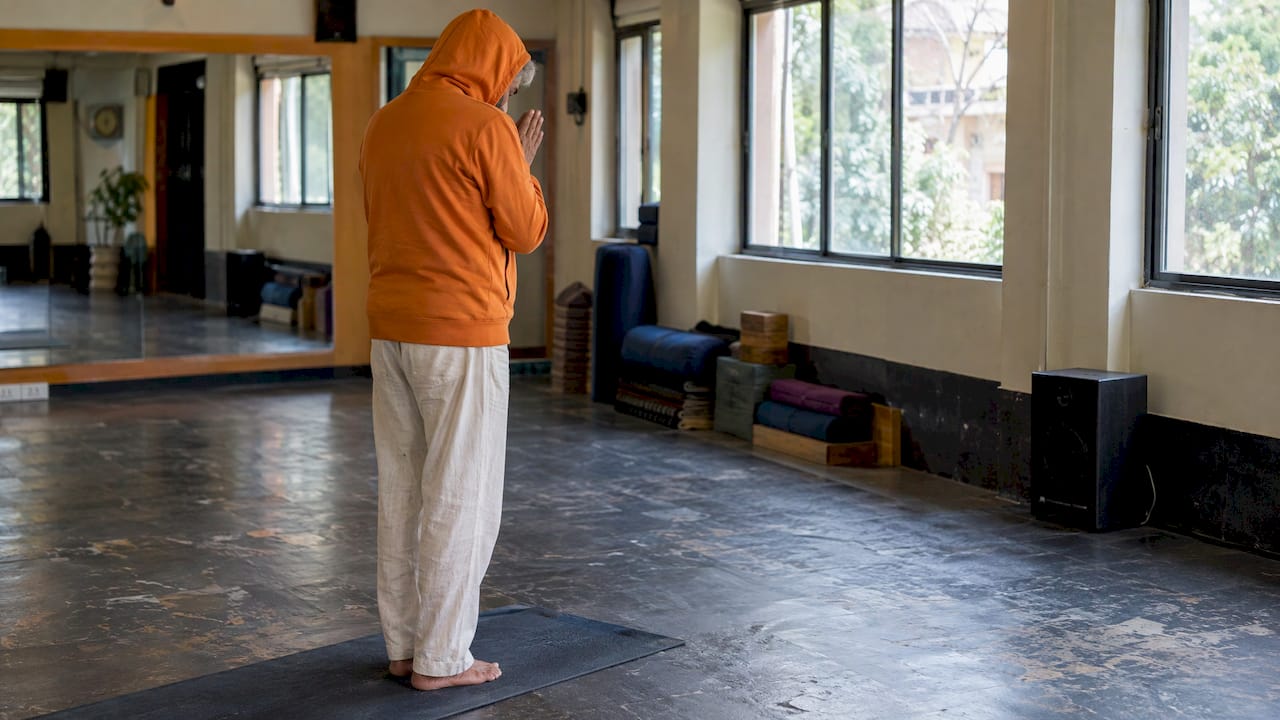
The practical principle is the one from the tempo section. Soft, slow music suits slow, inward practice such as restorative poses, breathwork and final relaxation. More rhythmic music can suit a dynamic flow, where the beat helps you move with your breath. Then taper down as you cool off and lie still.
A useful way to plan a class or home practice:
| Phase | What you want | Music that fits |
|---|---|---|
| Arrival and breath | Settling in | Very soft, slow, steady drone or chant |
| Warm-up and flow | Rhythm, momentum | Steady pulse, moderate energy, no abrupt changes |
| Peak or standing poses | Strength, effort | Brighter, more rhythmic, chant over a beat |
| Cool-down and floor work | Releasing | Slower and softer again |
| Final rest | Stillness | Gentle sound, or silence |
Silence at the end is a legitimate choice, and nothing says music must run for the whole session. If your practice leans toward the energetic side, take a look at our piece on yogic beats, where Vedic chant meets electronic rhythm.
Devotional and dance-influenced music as a focus tool
If your taste runs to bhajans, aartis or electronic rhythm, you are not choosing a lesser tool for focus. Devotional music was built for it.
A 2021 peer-reviewed study of kirtan, the call-and-response singing of sacred chants, in American Gaudiya Vaishnava Hinduism describes how traditional and hybrid kirtan move participants along a continuum from deep meditative focus to expressive bliss. It does this through progressive intensity: acceleration, crescendo, rising melodies and growing rhythmic density. In other words, sacred music has long been structured to guide attention, and a rhythmic pulse can be part of that structure.
This matters for EDM fans. Electronic music is also built around repetition, slow builds and a steady pulse. When the material is a mantra or an aarti, those same tools can give you a contemporary doorway into old practice. A 2025 review of sound interventions also noted that personal preference and cultural context shape the results, and that self-chosen music brought greater stress reduction than preselected pieces. If Vedic sound is part of your culture or curiosity, it is likely to land better than a stock playlist.
A practical way to use it:
- For stillness: pick the calmer, slower tracks and keep the volume low.
- For energy before focused work: use a rhythmic track for a few minutes, then shift to something quieter.
- For movement: use a beat-driven track during exercise or flow, then taper down.
To explore what lifts your mood, see positive energy music. If you are curious about the club-friendly side, our guide to spiritual house music is a good starting point, and energy healing music covers more reflective listening.
Music for focus from Tantric Guru
Tantric Guru blends ancient Vedic Hindu aartis and mantras with modern electronic dance music. The idea is a listening journey that invites a meditative state and a sense of joy and tranquility, whether or not you understand the lyrics. If you want a meditation soundtrack with a pulse, one that suits a morning sit, a focused work block or a yoga flow, you can find our original tracks for streaming and download on Spotify, Apple Music, YouTube Music, Amazon Music, Tidal and iHeartRadio.

Start with one track, follow the six-step routine above and keep it for a week. You can find the full catalog at Tantric Guru.
FAQ
What kind of music helps you focus?
Slow, steady music with few surprises helps most people. Research on slow-beat music found better attention to relevant targets and lower heart rate, and music you choose yourself reduced mind wandering in a 2023 study. Instrumental pieces, ragas, soft electronic textures and mantra music all fit when kept at a low volume.
Should meditation music have lyrics?
Lyric-free music is the easiest starting point, and you can switch to instrumental music whenever words pull you into thought. Chants and mantras can work as a sound texture, particularly when you are not following the meaning. Try both and keep what lets you return to the sound with the least effort.
How long should I meditate with music to improve concentration?
Start with 5 to 10 minutes and use a timer. Add a few minutes once the routine feels natural, and practice daily if you can. Consistency matters more than length.
What music works for yoga practice?
Match it to the phase of practice. Use soft, slow music for arrival, cool-down and final rest, and steadier, more rhythmic music for flow. Avoid abrupt changes, and feel free to finish in silence.
Sources
- Slow-beat music and attentional orienting study, 2025
- Effects of three genres of focus music on heart rate and attention, 2021
- Self-selected background music and task focus, 2023
- Impact of listening to Indian classical rāgas, 2023 meta-analysis
- Cardiovascular effects of music, 2012
- Music Meditation: Can Music Help With Meditation?, The Healthy, 2021
- How to Practice Music Meditation, Verywell Mind, 2024
- From Meditation to Bliss: kirtan study, 2021
- Effects of sound interventions on mental stress, 2025 scoping review