The Dhanvantari mantra is a prayer to Lord Dhanvantari, the divine physician of Hindu tradition, asked for health and protection. It comes in two common forms: the short "Om Dhanvantaraye Namah" and a longer verse that begins "Om Namo Bhagavate Vasudevaya Dhanvantaraye". Below you get the text of both, what each word means, how to say it, how devotees chant it and where it sits in the festival of Dhanteras. We make fusion music that blends Vedic aartis and mantras with electronic dance rhythms, so we also cover how to listen to a mantra if Sanskrit is new to you.
TL;DR
- Short form: Om Dhanvantaraye Namah, meaning salutations to Dhanvantari. Long form: Om Namo Bhagavate Vasudevaya Dhanvantaraye Amritakalasha Hastaya Sarvamayavinashanaya Trailokyanathaya Shri Mahavishnave Namah.
- The long form praises Dhanvantari as the holder of the nectar pot, remover of all illness and lord of the three worlds.
- Common counts are 11, 21 or 108 repetitions, but no count is compulsory, and customs vary by family and region.
- Devotees honor Dhanvantari on Dhanteras, two days before Diwali.
- Chanting is a devotional practice. It never replaces a doctor's diagnosis or prescribed treatment.
Table of Contents
- Who is Dhanvantari?
- The two forms of the mantra
- What the words mean
- How to pronounce it
- How devotees chant it
- Dhanteras and the Dhanvantari mantra
- What the mantra offers, and what it does not
- Why you may see different versions
- Listening to a mantra when you are new to Sanskrit
- Where our music fits
- FAQ
- Sources
Who is Dhanvantari?
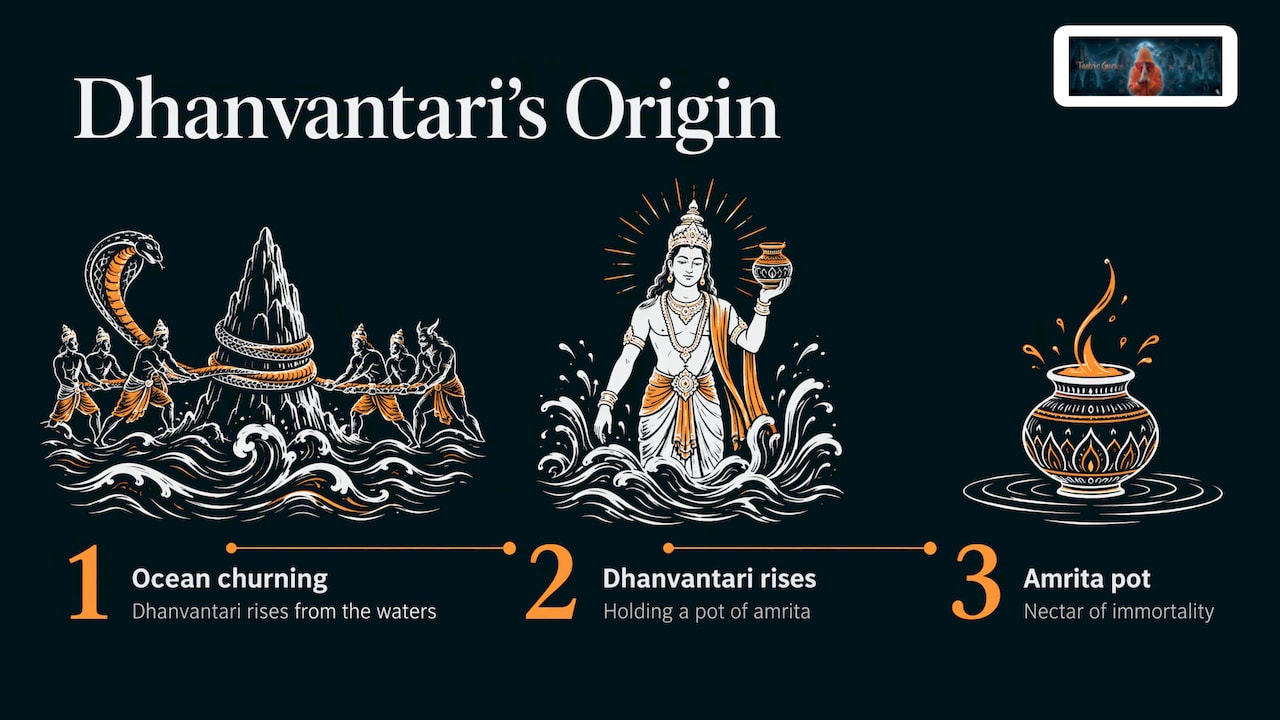
Dhanvantari is the god of Ayurveda, the traditional Indian system of medicine, and is regarded as a form of Vishnu. In the story of the churning of the cosmic ocean, he rises from the waters holding a pot of amrita, the nectar of immortality. The Bhagavata Purana, a major Hindu scripture, tells this episode, and Tirth identifies the passage as verses 8.8.31 to 8.8.34, where he is named and linked with Ayurveda.
That image explains the mantra. The pot of nectar is in the words, and the request is for wholeness and relief from suffering.
Diaspora temples publish the mantra too. The New York Ganesh Temple in the United States offers the text and its meaning, so you do not need to be in India to find a trustworthy version.
The two forms of the mantra
The short mantra
Om Dhanvantaraye Namah
In Devanagari: ॐ धन्वन्तरये नमः. It means "salutations to Dhanvantari". It is the easiest way in: five syllable groups, quick to learn, easy to repeat on a bead string.
A variant adds a seed sound: "Om Dham Dhanvantaraye Namah". A seed sound (bija) is a single syllable that devotional traditions use as a concentrated form of an energy or deity. Variants like this appear on pages such as Vaidika Vignanam, alongside the longer text.
The long mantra
Om Namo Bhagavate Vasudevaya Dhanvantaraye Amritakalasha Hastaya Sarvamayavinashanaya Trailokyanathaya Shri Mahavishnave Namah
The New York Ganesh Temple prints a transliteration with diacritics (marks that show long vowels and special sounds) that ends "Šri Mahã Vishnave Nama". Different sites place the spaces and hyphens differently, and Divya Marg notes that spelling varies slightly among published versions. This is normal: Sanskrit is written in its own script, and Roman letters are only an approximation.
What the words mean
Sanskrit mantras are built from names and descriptions, so you can read the long mantra line by line.
| Sanskrit words | Meaning |
|---|---|
| Om | The primal sacred syllable that opens most mantras |
| Namo Bhagavate Vasudevaya | Salutations to the Blessed Lord Vasudeva (Vishnu) |
| Dhanvantaraye | To Dhanvantari |
| Amritakalasha Hastaya | To the one whose hand holds the pot of nectar |
| Sarvamayavinashanaya | To the destroyer of all illness |
| Trailokyanathaya | To the lord of the three worlds |
| Shri Mahavishnave Namah | Salutations to the great Vishnu |
Put together, it addresses Vishnu in his form as Dhanvantari, honors the nectar he carries and asks for the removal of disease. You can hold that one-line meaning in mind while you chant. You do not need to translate each word in real time.
How to pronounce it
Most chanters stumble on three places.
- Dhanvantaraye: say it roughly as "dhan-van-ta-ra-yay". The opening "dh" is an aspirated sound, a "d" released with a puff of breath. AstroBhava warns that flattening it into a plain "d" changes the Sanskrit sound.
- Amritakalasha: "am-ri-ta-ka-la-sha". The "sh" is soft, as in "shine".
- Vasudevaya: "va-su-de-va-ya", with every vowel pronounced clearly and evenly.
A practical way to learn: say the short mantra ten times slowly, then add one line of the long mantra at a time. Listening to a recording while you read the text helps more than reading alone. Rhythm in Sanskrit chant is even, and every syllable gets almost the same weight.
How devotees chant it
There is no single official ritual. Households follow their own customs, and published guides say so. Here is the common home pattern they describe.
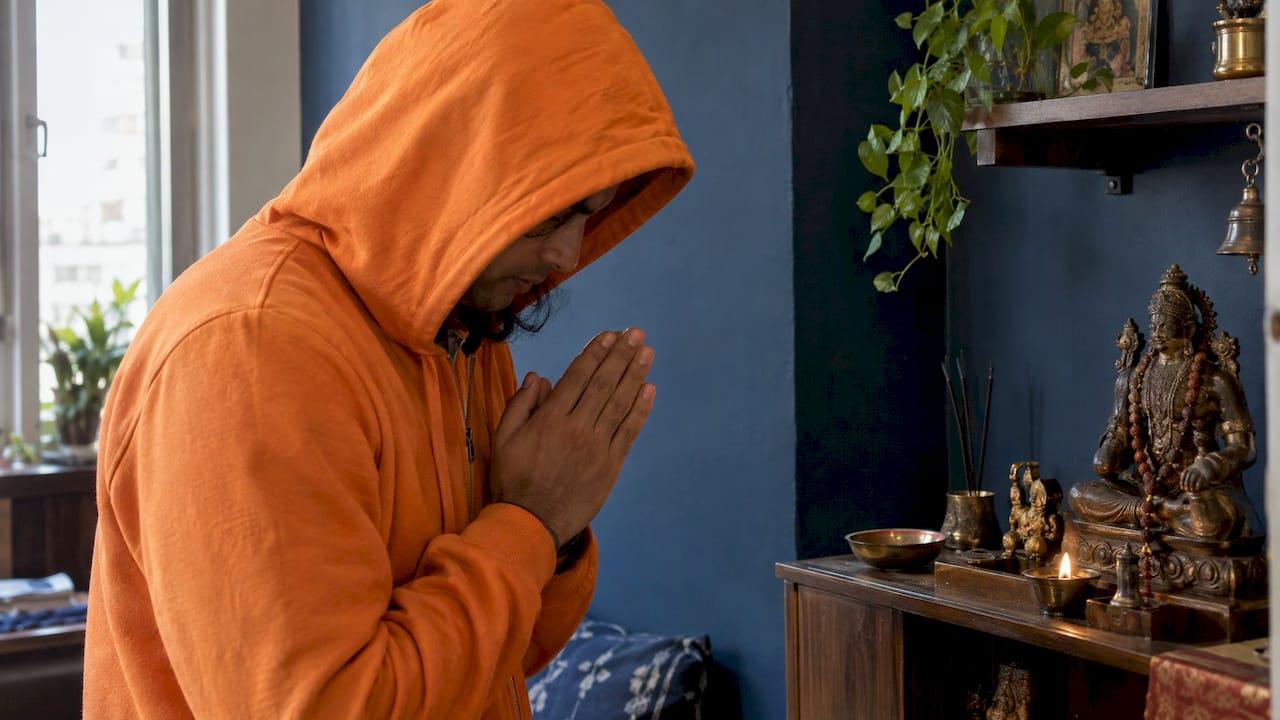
- Prepare the space. Bathe or wash, and tidy a small altar or a clean corner.
- Place an image. A picture or idol of Dhanvantari or Vishnu is typical. Many guides suggest sitting facing east or north.
- Light a lamp. A ghee or oil lamp is customary, and one puja guide advises keeping its flame facing east or north.
- Make simple offerings. Flowers and tulsi (holy basil leaves) are the usual choices, then fruit or sweets if you wish.
- Set an intention. Pray for the health of your family, not for a specific cure.
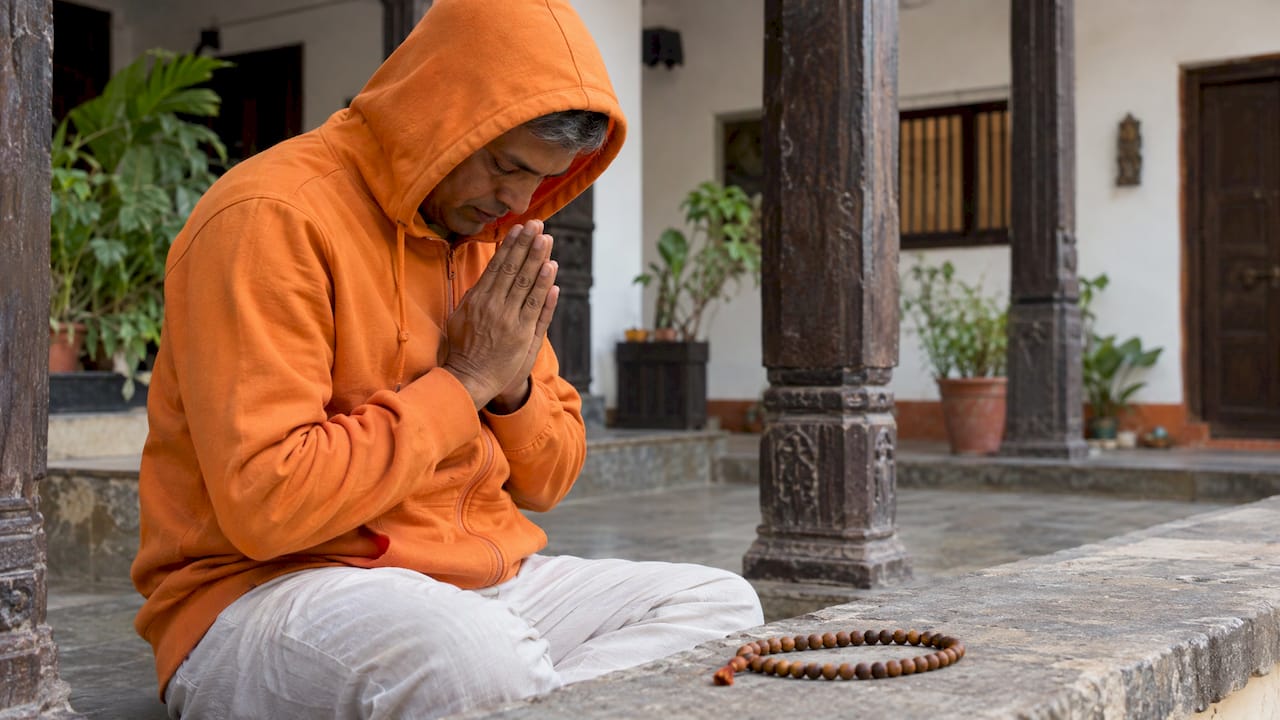
- Chant. The short mantra is often repeated 108 times, which is one full round of a mala (prayer beads). The long mantra is usually said 11 or 21 times. The same guide notes that there is no universal compulsory count.
- Close quietly. Sit for a minute in silence before you get up.
If you do not read Sanskrit, you can still take part: read the transliteration, listen along to a recording, or pray in your own language with a lit lamp and a flower. The point is attention and sincerity, not perfect recitation.
Counting with a mala
A mala has 108 beads plus one larger bead that marks the start. Move one bead per repetition and stop when you reach the larger bead. For the long mantra, 11 or 21 repetitions are easy to count on your fingers, and many people find them a calmer fit for a short evening sit.
Dhanteras and the Dhanvantari mantra
Dhanteras falls on Kartik Krishna Trayodashi, the thirteenth lunar day of the dark fortnight, two days before Diwali, the festival of lights. The date changes each year with the lunar calendar, so check a current Hindu calendar in the autumn. India's state broadcaster DD News describes it as the beginning of Diwali and a day dedicated to Dhanvantari, when devotees pray for good health, prosperity and happiness.
Many people know Dhanteras for buying gold or new utensils. The Dhanvantari link adds the idea that health is the first wealth. Divya Marg says that no single Dhanteras mantra is used by every household. Families choose according to their customs and the deity they worship. It suggests the Dhanvantari mantra during evening puja, after lighting a lamp and offering flowers. Some families add Lakshmi or Kubera mantras on the same evening, so follow your family's way.
What the mantra offers, and what it does not
Devotees invoke Dhanvantari for health, recovery, protection and longevity. For many, chanting brings steadiness: a regular time, a regular sound, a sense of being held in a larger tradition. That is a real part of why people return to it.
Safe practice also means keeping one thing clear. This is a devotional act, and it sits beside medical care, not in place of it. If you are ill or worried about symptoms, see a qualified doctor, follow the treatment you are prescribed, and never stop medicine because you are chanting. The mantra can be a comfort during recovery and a ritual for the family's well-being, and your doctor stays in charge of diagnosis and treatment.
Why you may see different versions
You will find several versions online, and that can be confusing. Three kinds of difference come up.
- Spelling: "Dhanvantaraye", "Dhanvantraye" and "Dhanvantri" all circulate. They are spellings of one name.
- Endings: some versions end "Namah", some end "Svaha", the word used at the close of an offering. A more compact ritual form ending "Vishnave Svaha" is published by Sanskrit Documents, which labels it a 41-syllable mantra.
- Expanded texts: a longer form beginning "Mahasudarshanaya" with extra titles is also in devotional circulation. Tirth says it could not establish a scriptural source for it and sets it apart from the shorter text most people print. If you want the form most widely recited, choose the long mantra given above.
A good rule: pick one version, learn it well and stay with it. Consistency matters more than which variant you choose. If your family or temple teaches a particular form, use that one.
Listening to a mantra when you are new to Sanskrit
You do not have to read Sanskrit to feel a mantra. Many listeners come to this practice through sound first and meaning later. A recording gives you the correct rhythm, a steady pulse to chant against and a shorter route into stillness.
If you want a wider palette of sacred syllables beyond this one, our guide to mantra examples covers 25 options, and mantras for relaxation shows how to fit them into a calm evening. If you are curious about how sound is used for wellbeing in a listening practice, see our piece on energy healing music.
A simple listening routine:
- Read the long mantra once with its meaning.
- Play a recording at a low volume and follow along silently.
- Join in quietly on the repeated phrase, "Dhanvantaraye".
- Finish with one minute of quiet.
Where our music fits
We at Tantric Guru make original tracks that fuse ancient Vedic Hindu aartis and mantras with modern electronic dance music. Our approach is built for listeners who want a meditative, joyful state whether or not they understand the lyrics. If you like the idea of a sacred chant carried by a steady electronic pulse, whether for a workout, a bhajan clubbing night or a quiet evening, our music is made for that. You can stream or download it on the major platforms, including Spotify, Apple Music, YouTube Music, Amazon Music, Tidal and iHeartRadio.

Start at tantricguru.com to find the tracks. To understand the idea behind the sound, read Yogic Beats: where Vedic chant meets electronic rhythm.
FAQ
What is the most common Dhanvantari mantra?
Two forms are in wide use. The short one is "Om Dhanvantaraye Namah". The long one begins "Om Namo Bhagavate Vasudevaya Dhanvantaraye" and ends "Shri Mahavishnave Namah". Beginners usually start with the short form and add the long one later.
How many times should I chant it?
Guides commonly suggest 108 repetitions for the short mantra and 11 or 21 for the long one. No count is compulsory, and families differ. Choose a number you can say with attention, and keep it the same from day to day.
Which mantra do I chant on Dhanteras?
There is no single mantra every household uses. Many people chant the Dhanvantari mantra during evening puja, after lighting a lamp and offering flowers, and some add Lakshmi or Kubera mantras. Follow your own family's tradition if you have one.
Does the Dhanvantari mantra cure illness?
Devotees chant it for health, protection and comfort, as an act of faith. It is not a medical treatment. See a doctor for any health concern, and keep taking prescribed medicine while you chant.
Sources
- New York Ganesh Temple: Sri Dhanvantari Mantra Japam
- DD News: Dhanteras, Honouring Dhanvantari, the Lord of Ayurveda
- Tirth: Vishnu Mantras, 5 Verses With Meaning and Their Source
- Divya Marg: Dhanteras Mantra guide
- AstroBhava: Dhanvantari Mantra
- Hindu Calendar: Dhanvantari Puja Vidhi
- Sanskrit Documents: Dhanvantari Mantra
- Vaidika Vignanam: Dhanvantari Mantra